
Take a stroll through Kharkiv in Spring 2026, and you’ll get the impression of normality: in Taras Shevchenko Park, you’ll see couples in love, pensioners taking a walk, and mothers with their strollers. The local Krystal café will be full of guests eating pizza or ice cream, children will be playing, and teenagers will be taking selfies in front of the magnificent light installations that decorate the park. On nearby Sumska Street and in many other places throughout the city, bars, cafés, and restaurants are open and lively. You’ll find shops where you can buy everything the heart desires, from books to groceries, textiles, wine, and delicacies.

Still, you will soon be reminded that the city lies in a war zone. One that Russia imposed onto the entire country by launching its full-scale invasion in 2022. Kharkiv lies less than 40 kilometers from the Russian border. Almost daily — often several times a day — Russia launches attacks from the nearby Russian city of Belgorod and other locations, sending military drones, glide bombs, ballistic missiles, or cruise missiles to terrorize Ukraine’s second largest city. As the evening approaches and things become quieter in the city, you can sometimes hear the rumbling of artillery.

Destruction in central Kharkiv. Photo: Björn Milbradt.
In many places throughout Kharkiv, the severe destruction is immediately visible — buildings everywhere are damaged, plywood replaces windows destroyed by blast waves, schools sometimes hold classes underground in metro stations. In some areas, you can still see traces of the cluster munitions used by Russia on streets and sidewalks. Like clockwork (especially at night), air raid sirens echo through the city. The alarms can last for hours. Due to Russia’s proximity, the warning time is extremely short. At the beginning of the Russian full-scale invasion, the Russian army stood at the outskirts of the city — but the Ukrainian Armed Forces successfully pushed them back.
Born from literal hellfire
In the first days of Russia’s full-scale attack, a volunteer kitchen was founded in Kharkiv that still exists today and can rightfully be described as a Kharkiv institution: Hell’s Kitchen (Pekelna Kukhnia in Ukrainian). The kitchen plays a quiet, yet important role in maintaining Kharkiv’s resilience and Ukraine’s resistance against Russian aggression.
Each day, Ukrainian and international volunteers work together to produce around 1,200 portions of food and approximately 600 bread rolls. The meals are delivered to hospitals, displaced persons, and other people and organizations in need.
Yehor Horoshko is one of the co-founders of the kitchen, where he works with his wife Liuda. One of Yehor’s friends decided to cook for the Ukrainian troops defending the city. It was an extremely tense situation, so they could use every bit of support. One day later, Yehor received a text message from his buddy asking whether he would help him set up this kitchen, through which the defenders of the city could be supplied.

Yehor at work. Photo: Liuda Horoshko.
During those first weeks and months of the war, not only did Ukrainian troops organize themselves for the fight against the Russian invaders, but numerous civilian initiatives were also founded, such as kitchens, evacuation teams, or distribution centers for food and other goods.
Yehor recalls that the situation at the time led to the kitchen’s name — Hell’s Kitchen: for Kharkiv, it was a hellish time on a knife’s edge. Many residents had fled or remained hiding in basements and bunkers for protection; the city was in danger of being encircled or occupied by the Russians, was under permanent Russian shelling, and at that time — unlike today — was also within range of Russian conventional, tube artillery.
He describes a ghostly and threatening atmosphere with empty streets and frequent detonations. The Russians were in the process of turning the city into hell, so Hell’s Kitchen became part of the resistance against the Russians.
For the delivery of food, Yehor recalls using the short periods in which the shelling was weaker and, as he suspects, the Russian attackers were changing shifts. Much of the destruction from that time is still present in the cityscape today, and new damage is added almost daily.
Among the most prominent scars comes from the March 2022 missile strike on the Kharkiv Regional State Administration. 29 people died; dozens more were injured. The northern districts of the city, such as Saltivka, bear especially pronounced traces of Russian shelling, as do many buildings and entire streets in the city center. In May 2022, the Ukrainian Armed Forces succeeded in driving the Russians out of the immediate surroundings of the city. During the counteroffensive of the following months, the entire Kharkiv region was liberated.
A bustling kitchen
It was during this time that Olena Hodz, one of the Ukrainian volunteers at Hell’s Kitchen, decided to return to Kharkiv. She had fled the city and remembers how she and her husband saw the explosions of Russian projectiles from their apartment on February 24, 2022.
While her husband, who runs a business in Kharkiv, soon returned to the city, it took Olena half a year after the beginning of the full-scale invasion. Since her children already lived abroad, she did not have to worry about their safety. Through friends in Lviv, she learned about a volunteer kitchen with a bakery in Kharkiv.
Olena had worked as a baker and confectioner long before the war; she’d even trained young people in those vocations. So she decided to return and volunteer for Hell’s Kitchen. “I realized that this was a project especially for me,” Olena says laughing, “and already the next day I was standing in the kitchen, baking.”
As head baker, she now prepares the dough, operates the kneading machine and the oven, and works together with the international volunteers who come to Kharkiv from all over the world to support Ukraine and Hell’s Kitchen. “We make this bread with our warmth, our heartfelt care, and we share this with the people who receive the bread,” Olena tells us, “Maybe it can remind them of their home.”
From 7 a.m. onward, the kitchen is bustling with activity. It does not subside until the afternoon and sometimes the evening hours. Delivery drivers take food and bread rolls to recipients throughout the city. At 7:30 a.m., the so-called “Veg Prep” shift begins, meaning four to five international volunteers peel and cut potatoes, carrots, onions, and other vegetables and assist the cooking team, which is mostly staffed by Ukrainian volunteers.
Around 9 a.m., the bakery shift begins. Four international volunteers and one or two Ukrainians prepare dough, operate the large oven and mixing machine. The dough is weighed and shaped into bread rolls, which are then baked, cooled, and packed for the recipients. At the same time, two volunteers work as “pot washers” and clean the large pots, trays, and pans in which the food is prepared.

Olena in the Hell’s Kitchen bakery. Photo: Björn Milbradt.
On a normal working day, around twenty volunteers work in different areas and with different responsibilities to provide fresh bread and meals to people in need. They are part of the resilience that defines today’s European metropolis of Kharkiv, as it confronts the Russian invasion.
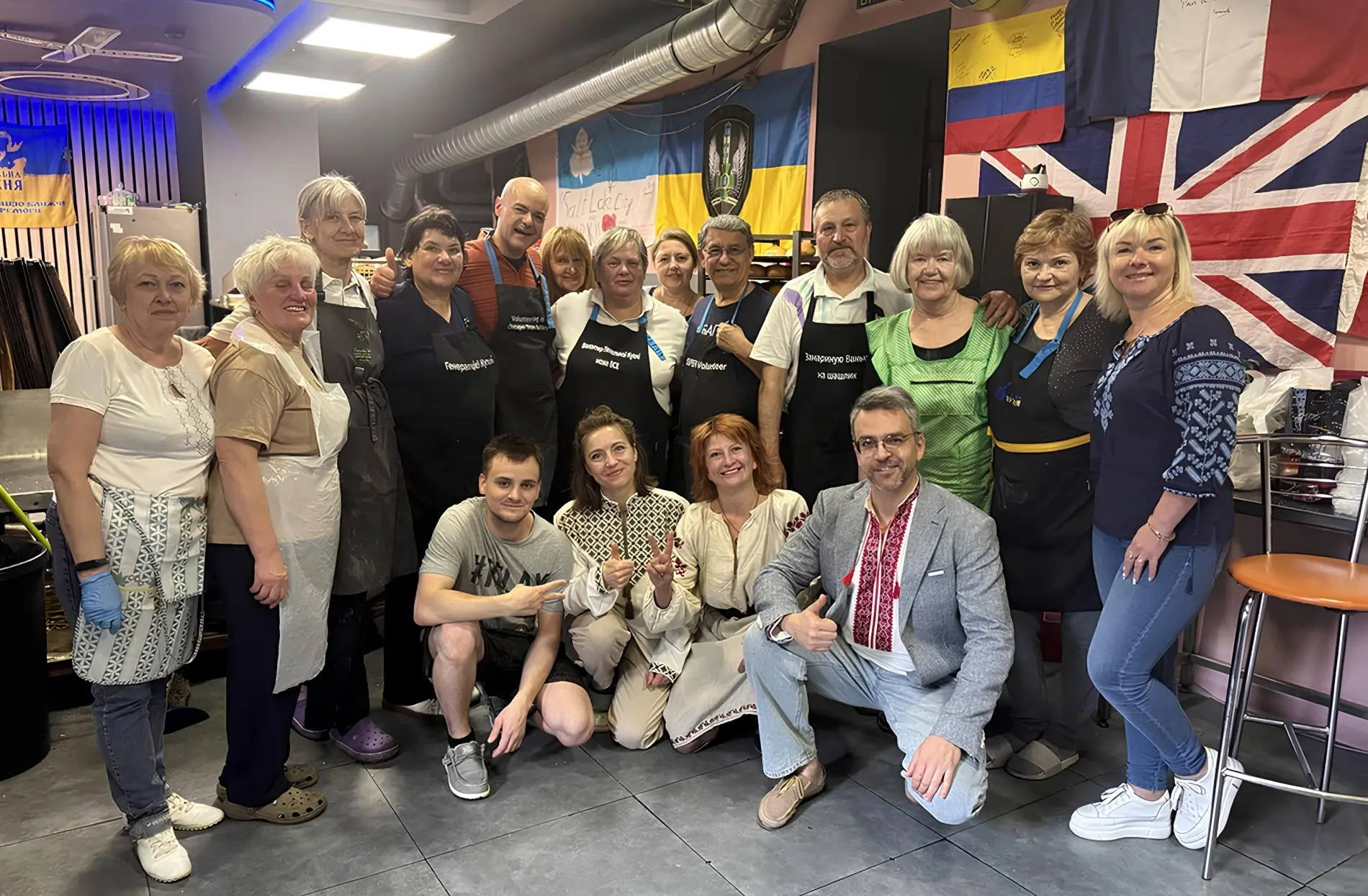
Anyone entering Hell’s Kitchen in the late morning finds a place full of activity, where people of many different nationalities bake, cook, chop, and knead. The atmosphere is jovial: volunteers often joke and play music. Ukrainian voices mix with English and countless other languages. Everyone is united by a common cause.
On the walls hang national flags from all over the world with messages of solidarity — as well as flags and patches from units of the Ukrainian armed forces.
A moral imperative
Yehor emphasizes how important the work and presence of the international volunteers are. The production of 30,000 meals per month is only possible through a great deal of volunteer contributions. When the first volunteer from Canada arrived in 2022, the team was staying permanently in the basement due to intense shelling. Despite the danger, volunteers continue to come and provide support, and, over time, a community of Ukrainian and international volunteers has developed.
Olena tells us how grateful she is for the presence of the international volunteers and how important she considers them. “History is being made here!” she says.
Fiona Hancock is a long-term international volunteer at Hell’s Kitchen. She says that, during the first days of the Russian large-scale attack, she followed the reports from there with growing horror. She recalls how, on March 9, 2022, she learned of the Russian bombing of the maternity hospital in Mariupol.
While the attention of the global public gradually fades, Russia’s brutal campaign and Ukraine’s defensive struggle have changed the lives of many international volunteers who have devoted much of their lives to supporting Ukraine and its people. Fiona explains it simply, telling us, “My partner and I had one glass of wine too many and thought, ‘Okay, let’s do something!’”

Fiona in the Hell’s Kitchen bakery. Photo: Björn Milbradt.
Speaking with foreign volunteers across Ukraine, a pattern begins to emerge: they felt immediate horror at the injustice, suffering, and brutality of Russia’s war. Then came a moral impulse to not merely stand by as spectators, but to actively support Ukraine. Many start with donations to aid organizations or the Ukrainian military before making the journey to volunteer in Ukraine. They join Ukrainians to work hand in hand against an enemy that seeks to eradicate Ukraine as a free, independent, and democratic country. Experts argue Russia would subsequently target other European countries beyond Ukraine.
For Fiona, solidarity work for Ukraine initially began in Poland, where she became involved with World Central Kitchen in Kraków for Ukrainian refugees. In addition, she specifically offered support and contacts for Ukrainians seeking refuge in her home country of Great Britain. Like other international volunteers, she gradually moved closer and closer to Ukraine and to the more dangerous regions, distributed humanitarian aid within the country, and came to Kharkiv for the first time in the winter of 2022. Fiona remembers a largely deserted, at times ghostly city that was heavily scarred by war.
After stays in the frontline cities of Kherson and Odesa, she learned about Hell’s kitchen during a stay in Lviv. There, Fiona met Franklin Orosco, an American volunteer at Hell’s Kitchen who — until recently — coordinated the deployment of the international volunteers there.
Since May 2024, Fiona has worked there, primarily in the bakery. She also is a coordinator for the international volunteers. She loves working in the kitchen: the baking, the appreciation from Ukrainian colleagues for the work of the international crew, and the certainty that her work is important for Kharkiv and for Ukraine.
Over time, Fiona says, the organization has evolved in various ways: more international volunteers are now coming, cooperation with the Ukrainians has become closer and better coordinated, and digital work schedules now exist, so everyone can sign up.
The work at Hell’s Kitchen is rigid and binding: whoever comes is firmly scheduled for the duration of their stay — up to six shifts per week, working four-to-eight hours per shift. For the kitchen, there are no days off. It needs to be staffed to operate on weekends and public holidays, because every day there is a need, and war also knows no rest.
The kitchen is also physically demanding: it requires preparing and shaping dough, loading and unloading the large oven, frequently carrying heavy supplies, such as sacks of flour or boxes of cooking oil. In summer, the kitchen can become extremely hot — the heat from the oven and the huge pots, trays, and pans on the stove exacerbate high outside temperatures, making the work sweaty and exhausting.
And yet Hell’s Kitchen faces no lack of applicants. Moreover, people travel great distances to work in Hell’s Kitchen: volunteers come not only from neighboring European countries, but also from the United States, Canada, New Zealand, Japan, the Philippines, and many other countries. And the road is not for the faint of heart. Due Russia’s aggression, air space above Ukraine has been closed to commercial planes since the first day of the full-scale war. Travelling to Kharkiv means first getting to Europe, then taking a bus, railway, or car — sometimes all three. If a volunteer arrives in Berlin, the last leg of the journey will still take another two days.

International flags in Hell’s Kitchen. Photo: Björn Milbradt.
The willingness of volunteers to embark on a tiring journey to work intense shifts in the sweltering heat is a testament not only to the importance of the mission, but also to the professional operation and the enthusiasm of the crew. It’s why many volunteers return again and again.
Asked how she deals with the everyday danger in Kharkiv, with the air raid alarms and attacks, Fiona explains that the greatest need for support naturally exists near the front line. “For example, we produce meals for a medical evacuation train,” she says, “You cannot do that in Lviv.” She tells us about a time she returned to Kharkiv after visiting family. As she stepped off the train, the first thing she heard was the air raid siren:
“It sounds strange, but it felt like coming home. That is how it is here; it is part of life in Kharkiv. Of course there is a risk, and every one of us who comes here accepts that risk. It is a wonderful city to live in. You do not see people here running into bomb shelters, because then they would spend their entire everyday lives in shelters. It is an almost defiant love of life that you see here. One of our volunteers said recently that he couldn’t think of anywhere else he worked that he loved better. And I feel the same way.”
Strong together
At the end, I ask each of the three — Yehor, Olena, and Fiona — what has not yet been said, what they would like to convey to international readers, and what people should still know.

Graffiti in central Kharkiv. Photo: Björn Milbradt.
Fiona says that we should always remember that this is an invasion against a free and democratic country:
“We know who the aggressor is, and we should not reward him. Please remember that this is a fight for the freedom of all of us and of our children — not only a fight of Ukraine. Do not forget us.”
And Yehor emphasizes that it is not only Ukraine that is threatened and attacked by Russia:
“My message to you is that you should not think that you need to help Ukraine out of charity. Europe is in the same war as Ukraine. We need to be strong together. Please believe me, citizens of Europe, that you are in great danger.”
Olena offers a way to help. Make the trek to Kharkiv, and volunteer:
“Come here. We need your support.”
Hell’s Kitchen can be supported via PayPal ([email protected]) and can be found on Instagram @hellskitchenkharkiv (in English) and @pekelna.kuhnya (in Ukrainian). Those who would consider volunteering at Hell’s Kitchen can find information at www.volunteeringukraine.com
