
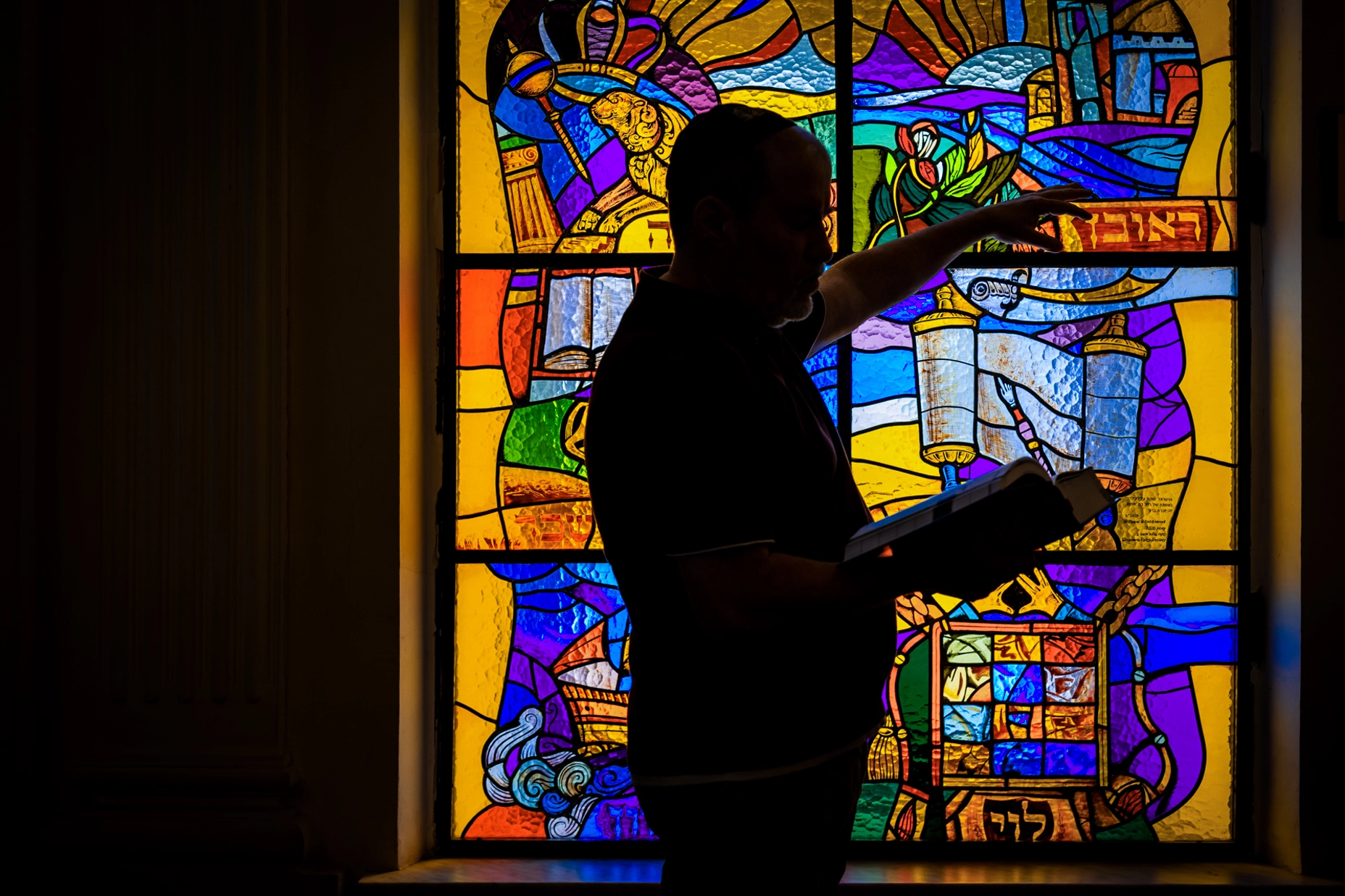
“Culture is what allows Ukrainians to feel stability and resilience — it’s our anchor in these difficult times,” says Yevhen Kotliar. He is one of the few researchers — perhaps the only — in Ukraine who study synagogue murals. When a missile damaged the stained-glass windows of a Kyiv synagogue, he was called in to restore them.
Yevhen Kotliar is a Jewish stained-glass artist and art historian from Kharkiv. In the early 1990s, he walked into a synagogue for the first time, unaware that this place would become one of the defining threads of his life. Here he would create his first stained-glass works, return years later, and eventually watch his work become part of the revival of the Jewish community in his home country. Through his research into Jewish cultural heritage in Ukraine, Yevhen speaks of synagogues as a portal into his own identity.
“What a terrible place this is”
At ten in the morning, following yet another ballistic attack on Kyiv, we meet Yevhen at the door of his apartment — a home struck three times, yet restored each time by his own hands. The artist and his family left Kharkiv for Kyiv in the early months of the full-scale invasion.
Yevhen opens the door of his apartment and invites us in, but pauses at the threshold. He runs his fingertips along a small silver case fixed diagonally to the right doorpost. This is a mezuzah — a small case containing a parchment scroll inscribed with passages from the Torah. By tradition, every Jewish home must have one as a mark of devotion to God’s commandments. Yevhen says a prayer. He touches the mezuzah again, raises his fingers to his lips, and kisses them.
And here is the aftermath of the shelling on his home — a bullet pierced a bedroom wall, and cuts from shattered glass mark the furniture where the windows blew out. Yevhen points around animatedly: this was replaced, this will be fixed, because the main thing is that he and his family are unharmed. Then he glances at the wall, where a single child’s drawing — a gift from his daughter — is hanging. Painted on it are a synagogue and a chuppah. A chuppah is a wedding canopy: a piece of cloth stretched over four poles, forming an arch under which the bride and groom stand, awaiting God’s blessing. Yevhen smiles:
“That drawing shows the Kharkiv synagogue! My daughter captured it so well. When I walked in there for the first time, back in the mid-1990s, it was a pivotal moment in my life. It felt as though I’d stepped onto another planet. I didn’t know much back then, but I understood that within those walls, people prayed to God.”


slideshow
Yevhen was born in Kharkiv in the 1970s. He grew up in a fully assimilated family, and although his relatives were Soviet in their mindset, they deeply respected their Jewish heritage.
“It was during the Soviet era, and the synagogue had only just been returned to the community. Restoration was in full swing. Before that, I used to go there when it was still a movie theater; there was also a sports club where my father wrestled. An inscription on the synagogue doors read: ‘How awesome is this place! This is none other than the house of God.’ It means that anyone entering should feel a sense of sacred awe. To this day, I walk into a synagogue with the understanding that something beyond human understanding happens here. Later on, I channeled that sense of awe into my own work — designing Jewish museums and cultural centers.”
Yevhen has many ties to the first synagogue in his life: he devoted his thesis projects to it while studying at the Kharkiv Art and Industrial Institute, and he designed stained-glass installations for it. His children studied there as well. He even met with the family of the architect who designed the building. Yevhen still keeps a mezuzah from that Kharkiv synagogue. Yet he says his fondest memories from there are of his own chuppah. He immediately recalls how long he spent selecting a wedding band for his wife, as the ring had to be made of solid gold, completely smooth, without any cuts or engravings — according to Jewish custom.
“On the day of the ceremony, I hid away in the synagogue, as if I weren’t even there. Then, according to custom, the groom is led into the room where the bride is sitting — and they walk him in very slowly.”
“By tradition, rabbis accompany the groom during a Jewish wedding ceremony, holding him by both hands. There is a deeper meaning behind this — marriage is considered a profoundly difficult emotional, psychological, and social transition from one status to another. The ritual exists so a man can fully grasp what he is stepping into and what it obligates him to do.”
“In short, yes, the synagogue has been a defining theme throughout my life, in every sense”
Art became central to Yevhen’s life when he was eleven, as he always possessed a distinctly artistic mindset. But his desire to explore Jewish culture awoke later, after finishing art college. It coincided with the growth of the Jewish youth movement in Kharkiv. As part of that movement, Yevhen began immersing himself in Ukraine’s Jewish heritage — a focus that has profoundly shaped his work ever since.
His current work is both varied and demanding — artist, professor, exhibition curator, stained-glass restorationist, scholar, and researcher. Unfortunately, due to constant moves and shelling, it wasn’t possible to see his studio and workspace, but he has a bookcase at home that speaks volumes about him. The items gathered there can scarcely be called a mere collection: photographs of synagogues, decorative fragments, catalogs, stained-glass sketches, vintage books, clippings, and modern art magazines.

Yevhen eagerly speaks about his work: for instance, together with German colleagues, he created the traveling exhibition “Painted prayers: Synagogue Paintings of Ukrainian Bukovina at Risk.” He is virtually the only researcher in Ukraine studying synagogue wall paintings. Holding a catalog of stained-glass sketches, he shares his plans:
“The main goal I set for myself is to use these exhibitions to bring people closer to Ukrainian Jewish heritage.”


slideshow
He has been traveling across Ukraine since 2004, researching burned synagogues and disappearing Jewish market towns (shtetls), which inspired his traveling photo project, “Ukrainian Shtetl: Homecoming to Places of Strength.” It premiered in New York in the summer of 2024 and continues to tour — having recently opened in Dnipro, with an upcoming display at the Sholem Aleichem Museum in Kyiv this October. The exhibition features black-and-white photographs that capture the haunting atmosphere of these former shtetls.
In addition, Yevhen cares deeply about synagogues that are falling into ruin. He says he is currently fighting for the restoration and digital 3D scanning of the synagogue in Chortkiv.
Yevhen sets aside the books, clippings, and sketches and steps into the kitchen. He slices some chilled melon, explaining that it’s his favorite fruit for Rosh Hashanah. Then, he invites everyone to take a seat at a round white table and continues his story about synagogues. He notes that since the start of the full-scale war, he has received numerous invitations to lecture on Ukraine and, specifically, its Jewish heritage.
“At these meetings and events, I’ve been explaining that our main challenge right now is to feel cohesion and unity, despite our differences. I believe our diversity should be the source of our value, not the other way around. And Jewish heritage is precisely the mortar that binds it all together. But to realize this, you have to go, see, and experience it for yourself. That is what I am working towards — making sure there is something to show and stories to tell.”
In addition to abandoned synagogues, Yevhen also supports active ones. For instance, he witnessed the restoration of the Rozenberg Synagogue (also known as the Great Choral Synagogue) in Kyiv’s Podil neighborhood, which was where he first worked as a stained-glass craftsman. After moving to the capital, the historic building became a new spiritual home for the artist and his family. During a freezing winter with persistent blackouts, they found shelter there for a time. Then, in October 2025, the synagogue was damaged in an attack on the city — with the stained-glass windows suffering damage as well.
In his bookcase, Yevhen keeps more than just art collections; he also has family photos and a menorah — the traditional seven-branched Jewish candlestick. Holding it in his hands while standing opposite the shattered windows of his apartment, the artist invites us to walk over to the Podil synagogue to see how the once-damaged stained-glass windows have been restored and are once again letting the light pour in. He adds with conviction:
“Culture is what allows Ukrainians to feel stability and resilience; it is our anchor in these difficult times. It gives us a sense of purpose and meaning in life.”

The Podil synagogue
At 29 Shchekavytska Street in Kyiv stands the Great Choral Synagogue. Its stained-glass windows are covered with a protective film to shield them from further Russian attacks. The building has no front entrance. Yevhen explains that it features a fake facade — the doors exist, but they do not open. It was a clever workaround used by Kyiv’s Jewish community back in the 19th century, when they were forbidden from building synagogues in the area. The structure was initially erected as a regular residential house, but just a year later, in 1894, it opened as a house of worship. The brick building, constructed in the Moorish Revival style, is enclosed by a wrought-iron fence.
“This synagogue is a symbol of Kyiv’s Jewish community. On one side, there’s a hotel, and on the other, a yeshiva — a religious school where young men study the Torah and the Talmud. Part of the building also houses a Jewish school. There aren’t many people here right now because of the war, but the synagogue has never closed its doors during the invasion. In fact, after World War II, it was never closed at all — remaining Kyiv’s only active synagogue for decades.”

“Thousands of Jews would gather here for major Jewish holidays — Rosh Hashanah, Yom Kippur, Passover, and others. The place was packed to the gills. People were standing all around the synagogue; every spot was filled,” Yevhen says, a note of sadness in his voice. “Now, because of the war, the demographics have shifted, and the congregation is significantly smaller.”
To the right of the synagogue is a hotel with an open rooftop area. The local Jewish community uses it during Sukkot—one of the primary holidays in Judaism, which commemorates the Israelites’ journey through the wilderness after leaving Egypt. Traditionally, right there on the open-air roof, they build huts using tree branches.
While we speak with Yevhen, cats bask in the sun in the synagogue courtyard. One friend after another stops to greet the artist — some ask how his damaged apartment is faring, while others wonder what brings him out so early in the morning. A woman with a stroller pauses to ask when his upcoming exhibitions open. He answers briefly before turning back to our conversation.
In the courtyard, he points out the mikveh — a space for ritual bathing with separate facilities for men and women. The ritual holds particular significance for women, who immerse themselves midway through their menstrual cycle (around days 12 to 14 after its onset). According to tradition, the water must be natural and flowing rather than stagnant — one reason synagogues were historically built near bodies of water. The synagogue grounds also house a bakery, a small workshop that produces matzo, traditional Jewish unleavened bread made solely from flour and water.

Yevhen reaches for his kippah — the small, round head covering traditional for Jewish men — and puts it on. Women, on the other hand, may enter the synagogue without a head covering, though some choose to wear a wig.
We step inside the synagogue, where everything falls quiet. The door shuts heavily behind us, and the first thing that catches the eye is three stained-glass windows, their colored light reflecting off the walls. Below them are three stone washbasins, with double-handled metal cups attached beside them on thin chains.
One of the stained-glass windows depicts the main symbols of the Kyiv synagogue: two hands representing the blessing hands of Jewish priests dating back to biblical times. Above them are stylized clouds, symbolizing the synagogue receiving a blessing from God. The second window depicts the tragedy of Babyn Yar, while the third centers on the rebirth of the Jewish community, featuring subtle Zionist motifs that underscore the theme of Jewish renewal.
Before entering the prayer hall, Yevhen fills a double-handled metal cup from the tap above the stone washbasin and pours water over his hands up to his forearms. He then recites a special blessing. Silence.

“After praying, you go to the table, break off a piece of bread, recite the full prayer once more, and only then are you allowed to eat or speak. While the person leading the meal tears off that first piece of bread, everyone waits. Between these moments, a special atmosphere must be preserved — the Almighty’s blessing over the food. My point is that meals can take place right here in the synagogue. Look, there are even wooden tables over there,” he says, gesturing toward the furniture in the corner.
The prayer hall is bathed in soft light from the stained-glass windows. The walls are painted white, framed by benches in a warm, rich brown. Above is the women’s gallery — a balcony reserved for women, as traditional Jewish custom separates men and women during prayer. Below are rows of seating for the men. In the center stands the bimah, and there, nestled among all the traditional relics, a blue-and-yellow Ukrainian coat of arms (tryzub) catches the eye.
“Sometimes the congregation comes just to pray, but mostly people want to hear the rabbi—what he will say and what wisdom it holds.
People are looking to interpret the words of the Torah so that, even while reading about something from ancient biblical times, they can find the answers hidden within it for today.”
Yevhen goes on to explain the synagogue’s wall paintings and their significance, drawing us deep into Jewish tradition with his stories. Almost unnoticed, we draw nearer to the stained-glass windows flanking the main bimah. The light filtering through them shifts constantly, shimmering in hues of yellow, deep crimson, and blue.

“Lord, that’s right in front of my windows”
Yevhen recalls visiting this Kyiv synagogue for the first time 21 years ago. He had come for the Rosh Hashanah holiday. It was then that he first saw how the stained-glass windows worked: how the light shifted throughout the day and how it transformed the synagogue’s space. Even so, looking at them through a professional eye, he thought about details that could still be improved. Years later, that opportunity finally came—though the occasion was far less celebratory than he would have hoped. In October 2025, the synagogue suffered damage in a Russian attack, and Yevhen took on the task of reconstructing the damaged stained-glass windows.
As he inspects his work today, he gives us a brief tour through the history of Jewish stained-glass art. He explains that anything related to fine arts was long considered non-kosher in everyday Jewish life—unless it directly served religious tradition. Many artists, he notes, began their careers within faith communities: some painted synagogue interiors, while others carved matzevot—traditional Jewish headstones.
“Stained glass itself isn’t strictly a Jewish tradition. It came into use around the 10th century, mostly in Reform synagogues. It’s essentially a Catholic tradition—you wouldn’t find it in traditional Jewish shtetls. They might have used glass, but it was very simple and geometric, maybe inserting a few diamond shapes, and that was enough. But stained glass as a work of art—that’s something completely different.

The idea behind Reform Judaism was that Jews in Europe had finally gained full rights alongside local citizens. Synagogues, therefore, had to be no less beautiful than the surrounding churches and cathedrals.”
As he explains this, Yevhen touches the stained-glass windows with evident pleasure, going on to describe how they are created:
“In stained glass, it is crucial to know how to evoke emotion—technically, artistically, and through imagery. We took individual pieces of glass that split a single color into shades. Then there’s the use of glass painting, which comes in two forms: either precise drawing or the inclusion of color gradients that give the stained glass its artistic expressiveness. The color scheme, the gradients—all of it brings a romantic quality to the light. It sparks emotion, forcing it to come alive.
ТThe technique behind creating stained glass is truly captivating. I’ll tell you more: it’s a craft where we never know exactly how the final piece will look until the very end.”
Standing beside the restored stained-glass windows, through which the morning light pours into the synagogue, Yevhen recalls the day of the strike:
“When I learned about it from the news, the first thing I thought was, ‘Lord, that’s right across from my windows. What happened to them? It’s glass—it had to be the first thing to shatter.’ I arrived here that morning and saw that, by some miracle, they had been spared.”

Yevhen explains that the blast wave swept along the ground. Fortunately, the damage was relatively minor, though two windows still had to be disassembled—he points out that in the lower tier of one, the glass remains slightly loose.
The artist worked to restore and reconstruct the damaged windows, drawing immense support from the community throughout the process Symbolically, the restoration was completed on the same day as the opening of his exhibition on stained-glass windows for Ukraine’s restored synagogues.
Yevhen says he is content with the work and glad that this space, which means so much to him, is filled with light. Looking up at the stained glass, wrapped as if in the gentle embrace of warm, colored light streaming down, he adds:
“I had a friend—an architect who designed homes, factories, warehouses, industrial plants, prisons, churches—everything. But he had never designed a synagogue. Toward the end of his life, he was immensely grateful that destiny gave him the chance to design and restore the Brodsky Synagogue. As a Jew, he understood that this might be the last work of his life. And so it was. It brought his life’s journey to a deeply symbolic close.”
Yevhen quietly gazes around the synagogue, knowing nearly everything about its history, murals, rebuilds, and restorations, as well as the life of the Jewish community here in Kyiv. He simply says: “Judaica is destiny.”

supported by
This publication was prepared within the framework of a partnership project with UNESCO, with the financial support of the European Union. Its content is the sole responsibility of Ukraїner and does not necessarily reflect the views of UNESCO or the European Union.
