

Bosnia and Herzegovina has long been viewed mainly through the lens of war — the fall of Yugoslavia and the consequent brutal conflicts that reshaped Europe in the early 1990s. Those events still undeniably affect the Balkans, yet many more questions need to be asked: how do wars affect societies in the long term, and what does the future hold?
In 2024, I spent a week in Bosnia and Herzegovina, mainly in the town of Prijedor, close to the border with Croatia. It is the place with the second-highest number of victims during the Bosnian War, after Srebrenica, and a region where all of the wartime concentration camps were located. Bosnia struck me as a combination of contradictions: a beautiful and peaceful place with a proactive civil society, yet with many unresolved past traumas and politically motivated ethnic divisions. This small country in the middle of Europe is still one of the least understood and explored, so it was a great opportunity to speak with Leila Bičakčić, one of the civil society leaders in Bosnia and the wider Balkan region.
The following is Leila’s direct speech.
What’s happening in Bosnia thirty years after the peace was signed
The clear advantage of the Dayton Accords1A peace agreement signed in December 1995 that formally ended the Bosnian War. It preserved Bosnia and Herzegovina as a single state divided into two entities: the Bosniak–Croat Federation (the Federation of Bosnia and Herzegovina) and the Bosnian Serb Republic (Republika Srpska), with a High Representative established by the UN. is that it stopped the war. We had four years of a very bloody conflict with many casualties. The genocide in Srebrenica2Also known as the Srebrenica massacre, it was a mass killing carried out by Serb forces of more than 8,000 Bosniak men and boys in and around the town of Srebrenica during the Bosnian War. was the last major crime committed prior to the final peace negotiations. All of this makes the peace accord essential. No casualty, no victim anywhere in any war is worth continuing a conflict.
What Dayton did not provide though was an expiration date, and that should be one of the lessons learned from Bosnia. It was expected that Dayton would end the war and provide a framework for peace and reconciliation until the country and its leaders became mature enough to sit together and produce a peaceful constitution. That never happened.
The current political debate in the country, which is highly aggravated, revolves around calls to return to the “original Dayton,” although no one truly agrees on what that original version represents. There have been numerous constitutional amendments resulting from negotiations within the country, and for some political actors, returning to the original Dayton would mean rejecting all those amendments, which is not possible.
As a result, the country now finds itself in a political deadlock. It’s split into two entities and one district: The Federation of Bosnia and Herzegovina, Republika Srpska and the Brčko District as an additional administrative level. Within the Federation, there are also ten cantons. In total, there are thirteen levels of government in a small country with a population of around 2.5 million. There is also no typical subordination between levels, meaning the state level is not truly in charge of the lower ones and does not have jurisdiction over them. Every canton, for example, has its own constitution.
We still have a High Representative who acts as the administrator of the peace accord. Our constitution is actually a peace document, a peace framework. We never reached the point of adapting it to contemporary conditions in the country. The High Representative therefore holds a mandate given by the UN Security Council — the UN body that oversees implementation of the peace accord. Thirty years later, the High Representative is still in charge.
Two components of the peace accord have still not been implemented, related to state property and military property that needs to be reassigned to the state. The relevant law has not yet been adopted, and this step should finalize the mandate of the High Representative, allowing the country to continue on its own. How soon that could happen is impossible to tell.

Reconciliation after the Balkan Wars
The problem is that we never actually reached the point of reconciliation at the political level. Right after the war and for many years afterwards, there were numerous reconciliation programs, but these mostly focused on reconciling citizens. There were programs working with children, with victims, particularly with women who were victims of wartime rape, as well as with former detainees from camps5During the Bosnian War, the Serb army created a range of concentration camps where they mainly detained the Bosniak and Croat populations of Bosnia. across the country.
There were also efforts involving former soldiers who had served in different armies and fought against each other during the war. But we never truly reconciled as a society as a whole in Bosnia and Herzegovina. Politicians, on the other hand, never reached the point of acknowledging what actually happened in the 1990s. The Bosnian war was not the only conflict in the territory of the former Yugoslavia; it involved a wider region and was partly triggered by the dissolution of Yugoslavia. The roles of different former republics, now independent states, in conflicts across the region will eventually have to be recognized, but this has never happened.
As a result, we missed the opportunity to reconcile and establish a common understanding of the basic truth. Thirty years later, children are still being taught through three different school curricula. Bosnia and Herzegovina is probably the only country in Europe with the phenomenon known as “two schools under one roof,” meaning children of different ethnic backgrounds attend classes in the same building but never meet.
When thinking about reconciliation, what we need is some form of truth commission for the territory of the former Yugoslavia, involving all countries that emerged after its dissolution, to establish basic facts about what happened in the 1990s and clarify the roles of different states. That would allow new generations to grow up with a shared understanding of history. Instead, we see competing narratives, often reaching back to the First or Second World War, or even earlier periods, in attempts to justify the violence of the 1990s.
Arguments revolve around who committed more crimes or who had more victims, but this cannot bring future generations together. Bosnia as a state has existed since the Middle Ages, though not within the current borders. It is always interesting to observe which period in history people choose when trying to claim they were first on this territory. It becomes particularly absurd when you consider how populations and empires have constantly moved, occupied territories, withdrawn, and changed borders over centuries. This is especially true for Bosnia and the Balkans as a whole. Such narratives are easy to sell because they rely on emotional blackmail, but they lead nowhere.
Another failure of the country has been the inability to build a shared identity of Bosnians and Herzegovinians. There is not a large percentage of people in Bosnia and Herzegovina who declare themselves primarily as citizens of the country. The primary identity for most people remains belonging to a particular ethnic group.

Responsibility of people in wars
The role of citizens is often underestimated, yet it can play a crucial role. Take Prijedor, for example — a place that is tragic in many ways. It was the first time after the Second World War that people were forced to wear visible marks, armbands, to show they belonged to a different ethnic group. The citizens of Prijedor knew what was happening, yet there was no reaction.
Read more
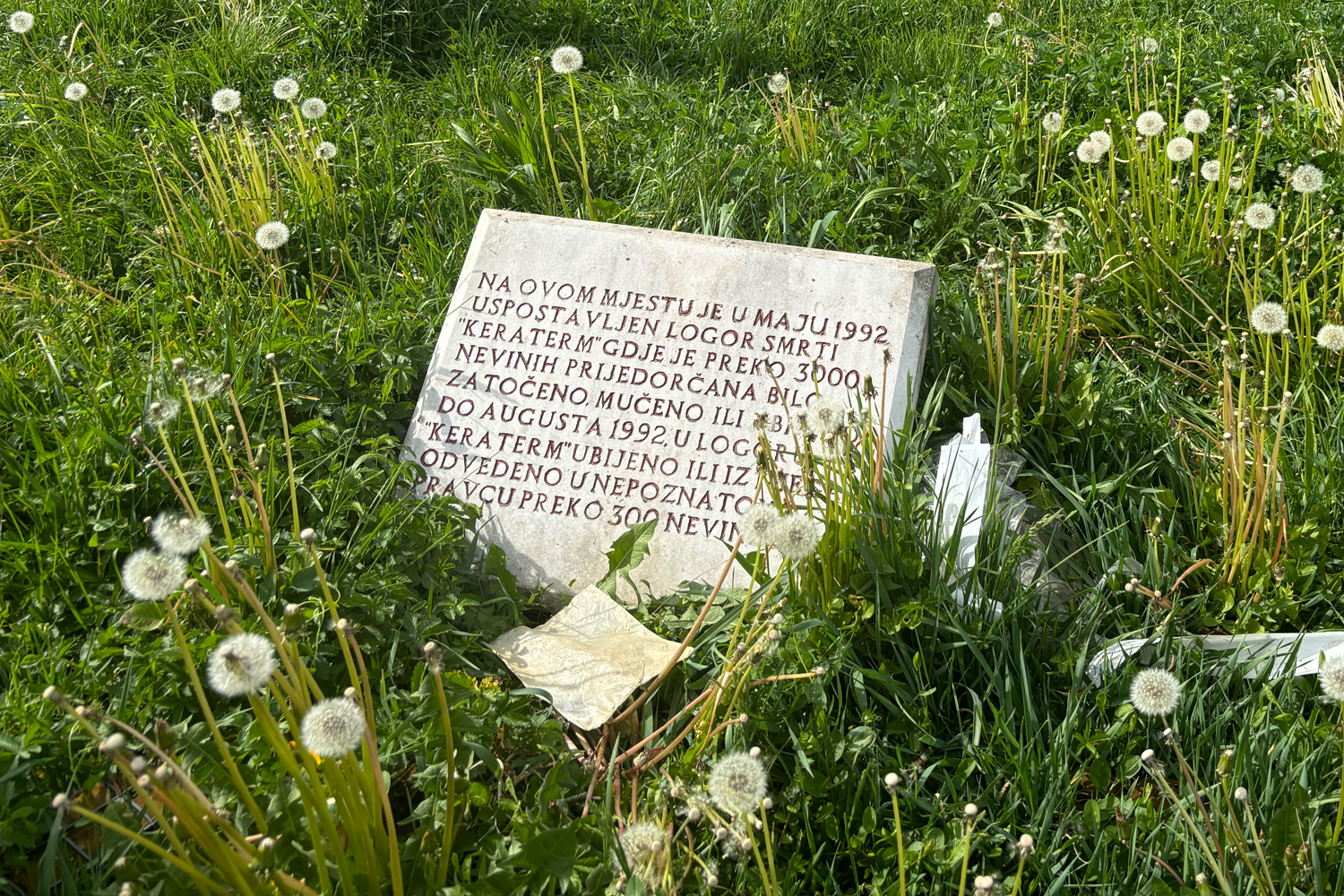
The idea that history will teach us not to repeat our mistakes has unfortunately proven wrong again and again. In this context, the responsibility lies with the citizens of Prijedor — and citizens elsewhere as well — especially those belonging to majority communities, to ensure the memorialization of victims from minority or outnumbered groups.
There is a movie called Quo Vadis, Aida? by director Jasna Žbanjić, that offers a powerful portrayal of the Srebrenica genocide and how it unfolded. I lived in Bosnia during the war and knew about Srebrenica, but the film gave me a much fuller understanding of the scale of events and the involvement of local people. It is devastating to realize that many people knew what was happening and did not react, and that some even helped create the conditions for the crime to occur.
It is always easy to dismiss responsibility by saying, “We were just following orders.” But even in Prijedor, while there were military camps and soldiers bringing people in, the camps could not have functioned without support from local communities.
There have been attempts by former residents who fled Prijedor during the war to create memorials, including one dedicated to children who were killed there. The 31st of May is commemorated as a memorial day for Prijedor, but every year there are difficulties organizing commemorations because local authorities refuse permission for permanent memorials or create obstacles for public gatherings.
All of this shows that society has not yet matured enough to fully accept the facts. We need to reach a point where we acknowledge what happened, learn from it, and build a better future.

Corruption as a political tool
Corruption is not the cause, it is a tool very effectively used by political leaders. They fuel ethnic hatred and deepen divisions to hide corruption behind ethnic politics. Since the end of the war, we have seen more and more political leaders becoming extremely wealthy — not just millionaires but even billionaires. All of this wealth comes from public funds, from money that should serve citizens and improve their lives.
Part of the problem may come from the socialist legacy, where state ownership created the perception that the budget is simply a pot of money — if I don’t take from it, someone else will. That mindset is still widespread. When you try to explain that the budget belongs to all citizens, many people respond that if they don’t secure a share for themselves, someone else will, and they will be left with nothing. Politics is therefore often seen as a way to get rich rather than serve the public, and many people still view politics as inherently corrupt.
Civil society, the media, and international programs have spent years making corruption a central public issue. Citizens increasingly recognize corruption as a problem and understand that it prevents the country from progressing. However, many still feel powerless to act against it and ask why they should report corruption if nothing changes.
This is also about trust in institutions. Many citizens do not trust that the system will work for them, so they try to find their own way around it. If they need medical treatment, they may feel forced to bribe a doctor to receive proper care. If they want to secure a place in kindergarten for their child, they may feel they have to pay someone to get on the list. Corruption becomes a substitute for a system that does not function properly.
The myth of Russian-Serbian brotherhood
Since Russia’s full-scale invasion of Ukraine began, the Russian embassy in Bosnia has become more vocal, openly warning about Bosnia’s potential NATO or EU integration and claiming such steps go against Russian interests. At the same time, support is provided to political actors in Republika Srpska who promote narratives about independence.

This political alignment contributes to ongoing instability in the region, particularly in Serbia and Republika Srpska, where Russian interests remain strong. At the beginning of Russia’s invasion of Ukraine, some analysts warned that if Ukraine had fallen quickly, the Balkans might have become the next area of tension. While turmoil in the region later subsided, signs of renewed tensions are again becoming visible.
This narrative has been developing for quite some time. The Serbian parliament has adopted declarations about an “all-Serbian union,” and we are seeing the influence of Serbian government-backed actors not only in Republika Srpska, but also in Montenegro, where parts of the political establishment reflect similar influences, and in Kosovo as well. So this is not limited to Bosnia; it concerns a wider region connected to this idea of broader Serbian unity.
Part of the explanation lies in what is often described as the Russian–Serbian “brotherhood” mythology, which is also linked to religious ties through the Orthodox Church. Over time, this connection has helped build a narrative of closeness, even though Russian influence in Yugoslavia was largely cut off after 1948. Still, the mythology continues to be reinforced.
If you look at the financial facts, Russian investments in Serbia or in Republika Srpska are actually quite limited. Yet the emotional narrative persists, and many people genuinely believe in this special relationship. Russian propaganda works over long periods, gradually building narratives that serve political interests. Following the breakup of Yugoslavia and the creation of new states, these narratives have been used to create uncertainty and instability in the region.
From Russia’s perspective, maintaining influence in the Balkans also serves the goal of staying close to the EU and creating tensions on its borders, as well as preventing further NATO or EU enlargement. It is a way to ensure Russia remains a relevant actor in regional and global politics.
We have long known about facilities such as the special forces center in Niš, Serbia, and recent Balkan Investigative Reporting Network investigations have also examined training camps connected to activities in Moldova. These operations appear where opportunities arise. In recent years, there has also been an increase in Russian diplomatic presence, including the expansion of consular activities in Banja Luka, while the embassy remains in Sarajevo.
In reality, during the wars of the 1990s Russia did not provide significant support to Serbia or Republika Srpska. The relationship appears to have developed more strongly in recent decades, primarily at a political level rather than through substantial economic assistance.
Understanding the region
Media outlets tend to report on countries like Bosnia, Ukraine, Moldova, or Georgia only when something bad happens, without investing in long-term cooperation or building understanding between societies.
Ukraine has received significant international media attention, but mainly in the context of war, without much deeper coverage that would help audiences understand Ukrainian society and its broader challenges beyond the war.
There was a strong international presence in Bosnia during the war, and that contribution has not always been recognized enough. Some of the atrocities committed in Bosnia, including the Srebrenica genocide, were first reported by international journalists. They were able to move between frontlines in ways local reporters often could not, and they helped bring crucial information out of the country during the war. Many of them later testified in The Hague and continued working on Bosnia-related issues. Some are still deeply connected to the country, regularly visiting, working with local communities, and contributing through training programs and professional exchanges. On a personal level, that commitment still exists.
What is missing today, however, is consistent international media coverage. The Balkans no longer have permanent correspondents for most major newspapers and magazines. Coverage usually appears only when something dramatic happens, and local journalists occasionally report for international outlets in those moments. Deutsche Welle maintains a presence, but it functions more as a news agency covering daily developments rather than providing deeper, sustained reporting.
What is needed is better and more regular media coverage of everyday developments and societal realities. That would help EU citizens better understand countries like Bosnia and others in the region beyond moments of conflict and crisis, and create a more informed basis for future cooperation and integration.
We host open conversations with a wide range of voices. The opinions expressed by our guests are their own and may not reflect our views.
