

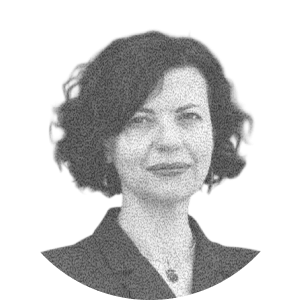
“The courage to have your own opinion is a hallmark of this moment in Ukraine,” says Olesia Ostrovska-Liuta, cultural scholar and director of Mystetskyi Arsenal. In this essay, she reflects on how institutions tasked with producing knowledge are caught in the grip of the entertainment market. She also raises the question of whether there is hope that our society will recognize culture as a factor of national security—not just in words, but in practice.
Written by
25 Strategic Questions
for Ukraine
A special project from the Frontier Institute and Ukraïner, where Ukrainian intellectuals and artists seek not only to identify challenges for Ukraine, but to create deep discussions around them, allowing for new contours of social development.
Project curator — Kateryna Botanova, Head of Media Projects at the Frontier Institute.
In the spring of 2022, at the very start of Russia’s full-scale war against Ukraine, I faced a question as the director of Mystetskyi Arsenal: Is a cultural institution needed during wartime? And if so, what is its purpose?
There were both philosophical and practical aspects to this question. Philosophically, it was about explaining to myself and my team the meaning behind our actions, and integrating that meaning into the larger context of resisting Russian aggression—a cause that felt shared by everyone in Ukraine. Practically, it was about deciding exactly what we should do, when, and how.
At that time, I came up with an answer based on three arguments (which seemed so important that I called them missions): Yes, cultural institutions must keep working during war. First of all, their work is crucial because they help preserve not only the physical side of culture—like museum artifacts—but also the intangible parts: traditions, practices, and informal or undocumented experiences. Second, these institutions build and provide platforms that amplify the Ukrainian voice internationally—whether through festivals, exhibitions, or a range of public events. And, third, cultural institutions serve as gathering places for people with shared experiences, where that experience can be spoken about and, in some way, processed. All of these arguments had to do, first and foremost, with resisting aggression and refusing to submit to annihilation.
But as time went on, it became increasingly clear that this was only the first, most basic level of working during wartime. The next level is culture’s ability to make sense of a tangible experience—to interpret it, turning it into a source of theory or a general understanding of the human condition or, for example, the state of a community. In other words, it’s about creating knowledge that’s grounded in real, concrete experiences and actions, as well as in the way ideas and people interact within a specific context.

Illustration: Anna Domanska
We saw this kind of thoughtful interpretation happening quite quickly in the practices of individual artists. A vivid example is Alevtyna Kakhidze’s graphic diary, in which the artist, even before the invasion and during the first weeks of the full-scale war, describes herself and the state of the world around her, often in distinctly political or analytical ways. Ukrainian soldiers’ literary works serve a similar function—for instance, Oleksandr Mykhed’s essay collection The Language of War, Artem Chapeye’s Ordinary People Don’t Carry Machine Guns, or Artur Dron’s Hemingway Knows Nothing.
Was this actually new for the Ukrainian cultural scene? At first glance, maybe not—after all, reflecting on the world is a basic function of any art form. But there was something different happening here, especially in the visual arts.
Theorizing Experience
I can’t shake the thought that before Russia’s war, in many artistic works and practices that described themselves as political—especially those of the R.E.P. group, which formed at the end of 2004 as a kind of artistic heir to the Orange Revolution—political and philosophical theory played a huge role, projecting itself onto the creative process.
It wasn’t real experience, but rather theory itself that often seemed to be the starting point for reflection. Most of it centered on leftist political and economic critique, often filtered through Russian translations or the practices of Russian artistic collectives at that time. After 2004, both the vocabulary and the themes and key questions that interested political art came more from literature than from real-life practice.
I mention Russian translations only because Ukrainian ones were lacking at the time, and not everyone had access to the originals, so the repertoire of humanities literature was shared by both the Ukrainian and Russian scenes. In fact, it was the Russian scene that shaped this repertoire, since Russian publishers or institutions were the ones producing, publishing, and debating the translations first and foremost. This added another layer of distance between theory and the lived experience of a particular society in a particular place and time. At the same time, such theory seemed more attractive because of its aura of internationalism and extraterritorial relevance.
However, with the start of the full-scale war, the very process of creating artistic expression changed: it depended very little on theory, especially the leftist agenda that focused on social welfare, anti-war stances, conscious disarmament, and the rejection of any discourse on national identity that has been widely accepted in the Western European art community (the very community the Ukrainian scene had recently become most integrated with). Now, artistic statements arose directly from experience and didn’t try to fit into any established theoretical framework recognized in international intellectual circles.
The reason for this, perhaps, was the sheer monstrous reality of war—something so overwhelming that it couldn’t be separated from oneself or distanced through popular theories. It was an intense confrontation with the unthinkable, for which no relevant theory was readily available. So, the next step became the attempt to make sense of this unthinkable reality.

Illustration: Anna Domanska
Along with Alevtyna Kakhidze, I’m also thinking about Lesia Khomenko’s latest works—her paintings break down video footage showing the very moment Russian troops are hit by kinetic weapons. There are also the Open Group’s video pieces, especially “Repeat After Me,” and Kateryna Aliinyk’s paintings: dark, almost macabre images of underground tangles of plant roots, weapons, and, seemingly, human remains. Not long ago, a perspective like Khomenko’s would have been considered completely taboo, since it could be seen not as a critique of war, but as a dehumanizing glorification of violence.
Yet each of these works is a commentary on lived experience—a way of creating new knowledge that arises from a unique, directly experienced situation, rather than from theory based on someone else’s reality. Of course, knowledge is produced in various ways, including through purely academic theories, and even mistaken interpretations can have significant heuristic value. And those artistic phenomena that, based on my intuition, once relied more on theory than on concrete lived experience, are still extremely important for Ukrainian culture. But until recently, both the Ukrainian academy and cultural scene sometimes lacked the courage to theorize based on their own social, political, and material reality, rather than trying to fit into established, “authoritative” theories.
Institutions of Knowledge Production
The courage to have your own opinion is a defining feature of this moment in Ukraine. You can sense it in the many conversations about decoloniality—a completely new perspective on Ukrainian reality that emerged with the full-scale war. How relevant this term actually is to our situation is a separate question. Still, this is one of those cases when a theory from a different context (and whose vocabulary often doesn’t quite fit the Ukrainian situation) stimulates self-reflection.

Illustration: Anna Domanska
But is this courage backed by the kind of resources that can give real longevity and stability to the process of reflection itself? More broadly, how does Ukrainian society view the ambition to produce its own knowledge—that is, to theorize based on its own experience or relevant theories?
This attitude is made clear in government policy, which in turn is reflected in how public funds are distributed. And no matter how much cultural professionals complain about the lack of cultural policy in Ukraine—a common refrain for many years—such a policy undoubtedly exists. It is shaped by the demands of the general public and is visible in the state budget.
Here are a few striking facts from the Culture Ministry’s analytical report, The State of Funding for Culture and the Arts from Local Budgets: Main Trends 2023–2024: since the start of the full-scale invasion, about a third of Ukraine’s cultural sector workers have left the country—this includes those working in publishing houses, museums, NGOs, libraries, festivals, and film production. At the same time, wages in this sector are about 30% lower than the average across Ukraine’s economy. Neither of these is a new phenomenon. Rather, these are chronic issues that have long shaped Ukraine’s knowledge sector, both in cultural and academic spheres. The war has only made them much worse.
A similar situation, though on a smaller scale, unfolded at the beginning of independence, in the 1990s—a time some people remember as phenomenally dynamic, and others as rather bleak. Those were the years when the old economic model was breaking down—when the state was the only employer in the country, and the sole source of funding for “economically excluded” institutions like museums and universities.
It’s important to understand that, before independence, these institutions weren’t seen as economic actors capable of or responsible for managing their own budgets. Instead, they were simply recipients of political directives that came bundled with the funding to carry them out. By political directives, I mean things like ideological functions—implemented through research policies, the way results were presented to the public, or directly through educational programs. When ideological work was suddenly abandoned, and along with it funding was slashed—sometimes entirely—these institutions were left paralyzed. They no longer understood their mission or their role in the new environment, and often couldn’t even afford to pay their staff.
This led to a sharp exodus of specialists who were able to find other sources of support—people who had rare skills at the time, like foreign languages, or who found a niche in the newly emerging free market, such as restorers or architects who became interior designers. In any case, the very institutions meant to generate knowledge through study and critical thinking often lost their most dynamic members. The result was a long period of stagnation and preservation, which severely limited these institutions’ ability to generate and safeguard knowledge—the kind of knowledge that should form the foundation of a society’s intellectual independence and geopolitical agency, or at the very least, its expert and political class.
Now, we’re once again heading toward that same point of stagnation.

Illustration: Anna Domanska
Consolidating Reflection
When the courage to think independently isn’t matched by the resources to support such work, it risks turning into imitation or, bluntly put, a parody of genuine reflection on experience and reality.
So, on the one hand, we have a creative process and authors who reflect on the human and societal situation during the war, grounding their work in concrete, real experience—the actual reality of their lives. And this is an important step in the process of producing knowledge.

At the same time, the next crucial step—building institutions that can help make sense of this knowledge, bring it into broader conversations, refine it, debate it, challenge it, and spark new ideas based on it—is still extremely weak.
The brief period of relative prosperity for institutions in modern Ukrainian history—in my view, the years from 2016 to 2019, when the Ukrainian Cultural Foundation and the Ukrainian Institute were founded and funding for some organizations like Mystetskyi Arsenal finally became relatively stable, making it possible to support programming and pay teams salaries that were competitive for Kyiv—ended up being too short to build any real capacity.
Similarly, even the best Ukrainian universities struggle to attract talented scholars because of extremely low pay and very high teaching loads, which leave little time for actual conceptual work. For example, if you divide the entire budget of the top ten most prestigious Ukrainian universities by the number of faculty, you’ll find that, for each professor, you get roughly $15,000 to $28,000 per year. These figures include all expenses, not just salaries. Still, according to public data, an associate professor’s monthly salary is currently around 15,000 hryvnias (about $336) per month. This makes such jobs cheap for employers but unattractive as a career for employees. One of the few exceptions is the Kyiv School of Economics, a small private university that aims to maintain a high standard of intellectual work thanks to much better working conditions than are typical in the education sector.
At the same time, cultural institutions—museums, theaters, cultural centers—exist in constant connection with their audiences, which, for lack of a better term, can be broadly defined as “the general public,” since these are people who don’t necessarily have a purely professional or academic interest in such engagement. This seems to create a certain opportunity—a possible way out of the chronic resource crisis that paralyzes institutions’ work. The public could, in theory, financially support its own institutions, right? Isn’t the huge buzz around some theater productions—like Ivan Uryvskyi’s “The Konotop Witch” at the Ivan Franko Theater in Kyiv—a chance to finally fix this chronic lack of resources? On the surface, it looks like the answer is yes. More tickets sold should mean better finances for the theater.

Illustration: Anna Domanska
But this kind of logic is more of a trap than a solution. Ukrainian theaters are regularly criticized for their conservatism and for endlessly reproducing familiar works in familiar interpretations. Perhaps the best symbol of this, up until the start of the full-scale war, was the annual production of Tchaikovsky’s The Nutcracker during the Christmas season on ballet stages across Ukraine. This highlights the situation facing cultural institutions: chronic underfunding pushes them to take entrepreneurial steps in the entertainment market—a space designed not for the creation of knowledge, but for amusement. This market operates within the “attention economy,” where popular products and flashy packaging matter most. What counts is the ability to grab the consumer’s attention, rather than encouraging the audience to become co-creators of meaning through intellectual engagement. This is what really lies behind the usual public complaints about these institutions having “bad communication.” It’s not so much about actual failures in communication, but more about an expectation that they’ll act according to marketing logic—even in spaces where the logic of knowledge should be what matters most.
The result of cultural institutions operating in the turbulent waters of the attention economy is often a retreat from anything complex or experimental—which, by its nature, might be a flop in terms of audience numbers, ticket sales, and revenue.
In fact, the neoliberal logic of constant entrepreneurial activity, when applied to those whose mission is meant to focus on reflection, actually stifles that very capacity for reflection.
But does this mean that knowledge production by cultural institutions is impossible within the framework of the attention economy? Probably not. We’ve seen more than once that certain projects can capture significant attention while also encouraging learning and reflection. At Mystetskyi Arsenal, for example, these include the annual Book Arsenal Festival and the exhibition “Vasyl Stus. While We’re Here, Everything Will Be All Right.” Other examples are Alla Horska’s “Boryviter” and Tiberiy Silvashi’s “Silvashi’s Circles” at the Ukrainian House. Why did these projects succeed in quantitative terms, even within the toxic environment of the attention economy?
National Security
All three of the exhibitions mentioned focus on figures who are emblematic for Ukrainian culture. Each one highlights an idea I would describe as “excellence in the past” or “remarkable predecessors.” In a society under stress—as is the case during war—there’s a need to find points of support and legitimacy, to affirm one’s right to exist by looking to the past. This is likely connected to the surge of interest in accessible history—seen in books, podcasts, and interviews with researchers.
Cultural figures from the past—especially those whose lives embody a certain understanding of Ukraine’s historical trajectory—also serve as sources of support and legitimacy.
This is especially true for artists of the Sixtiers movement and dissidents, and to a lesser extent for contemporary artists of the older generation, such as the renewed interest in Tiberiy Szilvashi’s work. But at its core, it’s the same kind of attention and curiosity. Does this process involve learning, and does it generate new knowledge? I believe it does, because such projects bring certain figures and phenomena into the public space, secure them a measure of media attention, and focus the interest of the professional community—however fragile and weakened that community might be. For example, this is exactly what happened with Mystetskyi Arsenal’s exhibitions devoted to the Boichukists (an important art movement of the 1920s) and to Paraska Plytka-Horytsvit, a Hutsul artist little known to the broader public, both held before the full-scale invasion. These projects established themselves in both public and professional circles as significant cultural phenomena, worthy of further study and presentation.

Illustration: Anna Domanska
But this is only one possible way of working with knowledge, and it’s absolutely insufficient for a full-fledged process. For lasting impact, meaning must be grounded in the invisible, painstaking work of research—a process that isn’t burdened by the pressure to win in the relentless competition for the public’s attention. Only this will allow Ukraine’s intellectual community and its institutions to keep up with their own experience, process it, reflect on it, and offer well-grounded knowledge both to themselves and to the international arena.
Are Ukrainians capable of turning experience into knowledge?
There is some hope in the fact that today, far more Ukrainian scholars and artists are working in Western academic and cultural institutions than in previous decades.
This allows them to build a tighter network of connections among themselves and with colleagues who remain in Ukraine, and the density of this network helps consolidate limited resources. Yet this is just another crutch—maybe a bit more effective than those of previous years, but still not enough.
There is some hope in the recent changes in public discourse: declarations at many levels—from government to civil society—that culture is a factor of national security. As a result, institutions that make this possible should, in theory, receive more weight and resources.
But we’re not there yet. For now, these are just declarations, not real changes that can be tracked through the allocation of public funds—the question of what, and in what amounts, the political class representing the Ukrainian people actually finances. A major step—paradoxically—would be strengthening the Ministry of Culture itself, an institution that is extremely fragile and resource-depleted, often objectively unable to fulfill even its basic functions, such as ensuring the safety of museum collections. Creating a strong, well-funded department dedicated to these functions would show that Ukrainian society is truly serious about considering culture a matter of national security.
We’re not there yet, but this understanding is ripening in civil society, among politicians, and among cultural practitioners themselves. Perhaps this gives us a chance for the gradual revival and growth of knowledge institutions that won’t be pushed to the margins of the entertainment industry. Returning to the arguments I began this text with in support of the existence of cultural institutions, such institutions could then focus on what may be their fourth—and perhaps most important—mission: to reflect on the reality around us and offer theoretical understanding of real experience.
This translation was provided by the Frontier Institute, thanks to the support of PrivatBank.
